Ernst-Happel-Stadion
 (0 users)
Thumb
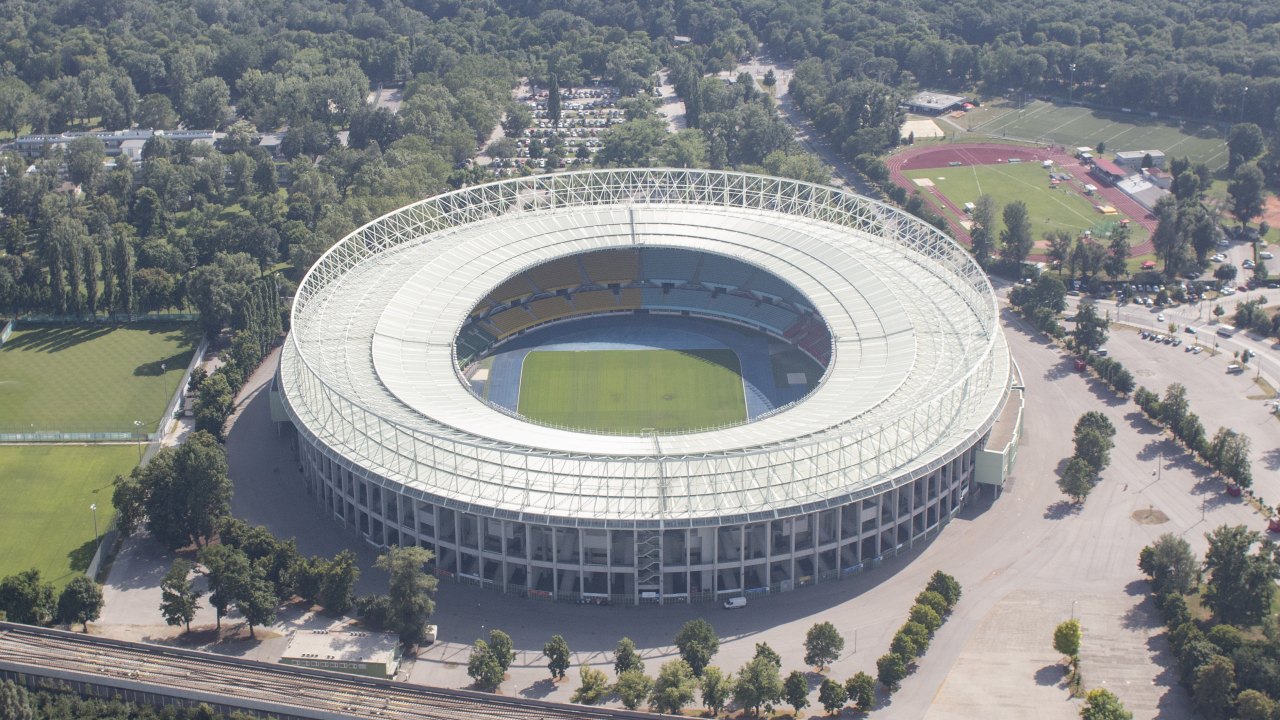
Image Source: Unknown report
Next Event
 Austria vs Ireland
Sat 14 Nov 2026 19:45
Established
0 (2026 years old)
Capacity
50,865
Build Cost
Architect
Country
International
Location
Meiereistraße 7, Vienna, Austria
Timezone
UTC +01:00 Central European Time (CET)
Coordinates

| Upcoming | |||
| 14 Nov | AustriaAustria  | 7:45pm |  IrelandIreland IrelandIreland |
| Results | |||
| 02 Oct | Austria UAustria U21  | 1 - 1 |  Denmark UDenmark U21 Denmark UDenmark U21 |
| 27 Sep | AustriaAustria | 3 - 1 |  KosovoKosovo KosovoKosovo |
| 01 Jun | AustriaAustria | 1 - 0 |  TunisiaTunisia TunisiaTunisia |
| 31 Mar | AustriaAustria | 1 - 0 |  South KorSouth Korea South KorSouth Korea |
| 31 Mar | Austria UAustria U21 | 2 - 1 |  Belarus UBelarus U21 Belarus UBelarus U21 |
| 27 Mar | AustriaAustria | 5 - 1 |  GhanaGhana GhanaGhana |
| 18 Nov | AustriaAustria | 1 - 1 |  Bosnia-HeBosnia-Herzegovina Bosnia-HeBosnia-Herzegovina |
Description
Available in:

The Ernst Happel Stadion (About this sound Ernst-Happel-Stadion (help·info)) (Praterstadion until 1992, sometimes also called Wiener Stadion) in Leopoldstadt, the 2nd district of Austria's capital Vienna, is the largest stadium in Austria. It was built between 1929 and 1931 for the second Workers' Olympiad to the design of German architect Otto Ernst Schweizer. The stadium was renamed in honour of Ernst Happel following his death in 1992. The stadium hosted seven games in UEFA Euro 2008, including the final which saw Spain triumph over Germany.
The stadium is owned by the City of Vienna (Municipal Department 51 - Sports of the City of Vienna). It is managed by the Wiener Stadthalle Betriebs und Veranstaltungsgesellschaft m.b.H., a subsidiary of Wien Holding.
History
1928-1945
The foundation stone was laid in November 1928 in honor of the 10-year celebration of the Republic of Austria. The stadium was constructed in 23 months, from 1929 to 1931. It was built according to a design by the Tübingen architect Otto Ernst Schweizer and the second Workers' Olympiad. Schweizer also designed the adjacent Stadionbad (with 400,000 sq m, Europe's largest swimming pool). According to its location in Vienna's Prater, it was initially named Prater Stadium. It was a modern stadium at the time, particularly in Europe, because of its short discharge time of only 7 to 8 minutes. Initially the stadium had a capacity of approximately 60,000 people.
During the National Socialist Era following Anschluss, (1938–1945) the stadium was used as a military barracks and staging area and as a temporary prison for the deportation of Jewish citizens. Between September 11 and 13, 1939, after the attack on Poland, over a thousand Polish-born Viennese Jews were detained on the orders Reinhard Heydrich. They were imprisoned beneath the grandstands in the corridors of Section B. On September 30, 1,038 prisoners were deported to the Buchenwald concentration camp. The next day, the stadium was back to being used for a football match. 44 men were released in early 1940, 26 were freed in 1945, the rest were murdered in the camps. In 1988, one of the surviving victims, Fritz Klein, was awarded a compensation by the Austrian government equivalent to 62,50 euros for being detained in the stadium. In 2003 a memorial plaque, commemorating these events, was unveiled in the VIP area by a private initiative. In 1944, the stadium was severely damaged during a bomb attack on the Wehrmarcht Staff offices.
1945-2000
After the war and the reconstruction of the stadium, it was again sporting its original use. In 1956, the stadium's capacity was expanded to 92,708 people by Theodor Schull, but in 1965 the capacity was reduced. The attendance record was 91,000 spectators set on October 30, 1960 at the football match between Spain and Austria (0-3).
In the mid-1980s, the stands were covered and fully equipped with seats. At its reopening a friendly match against archrivals Germany was organised. Austria won the match 4-1. After the death of former Austrian top player and coach Ernst Happel, the Prater Stadium was renamed after him in 1992. In 1964, 1987, 1990, and 1995, the Ernst Happel Stadium was the venue of the European Cup/UEFA Champions League final.
In 1970, the stadium was the venue of the 1970 European Cup Winners' Cup Final which saw Manchester City F.C. beat Górnik Zabrze by 2 goals to 1 in an entertaining match. Neil Young and a Francis Lee penalty sealed the win for City. This final was played under torrential rain in what was then an uncovered stadium. This along with the fact no Polish supporters were allowed to travel to the match restricted the attendance, which is variously reported at between 7,900 to 15,000 spectators. Even so, City's travelling support numbered over 4,000 which was a then record for an english club playing on continental europe.


Tennants
   Austria Austria |  Austria U21 Austria U21  |
Collections
None...
Fanart


Other Links