Estádio do Morumbi
 (0 users)
Alternate: Estádio Cícero Pompeu de Toledo
Thumb
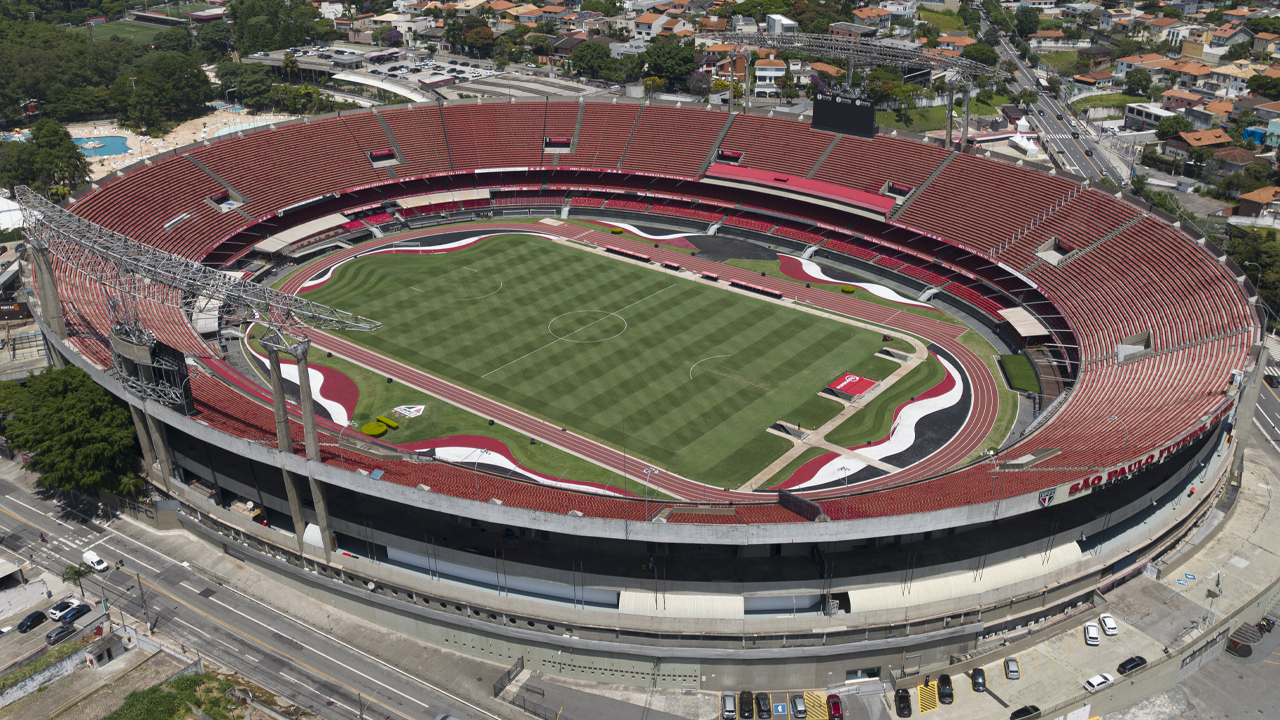
Image Source: Unknown report
Next Event
 São Paulo vs Vasco da Gama
Sun 18 Oct 2026 00:00
Established
1960 (66 years old)
Capacity
67,000
Build Cost
Architect
Country
Brazil
Location
São Paulo
Timezone
UTC -03:00 Brasília Time (BRT)
Coordinates
23°36′0″S 46°43′13″W

| Upcoming | |||
| 18 Oct | São PauloSão Paulo  | 12:00am |  Vasco da Vasco da Gama Vasco da Vasco da Gama |
| 05 Nov | São PauloSão Paulo | 12:30am |  CorinthiaCorinthians CorinthiaCorinthians |
| 18 Nov | São PauloSão Paulo | 9:00pm |  FluminensFluminense FluminensFluminense |
| 29 Nov | São PauloSão Paulo | 9:00pm |  RemoRemo RemoRemo |
| Results | |||
| 11 Oct | São PauloSão Paulo | 2 - 1 |  VitóriaVitória VitóriaVitória |
| 02 Oct | São PauloSão Paulo | 1 - 2 |  SantosSantos SantosSantos |
| 20 Sep | São PauloSão Paulo | 1 - 0 |  InternaciInternacional InternaciInternacional |
| 16 Sep | São PauloSão Paulo | 1 - 1 |  Boca JuniBoca Juniors Boca JuniBoca Juniors |
| 05 Sep | São PauloSão Paulo | 2 - 0 |  Atlético Atlético Mineiro Atlético Atlético Mineiro |
| 29 Aug | São PauloSão Paulo | 2 - 1 |  BragantinBragantino BragantinBragantino |
| 19 Aug | São PauloSão Paulo | 3 - 1 |  BolívarBolívar BolívarBolívar |
Description
Available in:

The Estádio Cícero Pompeu de Toledo, widely known as Morumbi (Brazilian Portuguese: ), is a football stadium located in the Morumbi district in São Paulo, Brazil. It is the home of São Paulo Futebol Clube and its formal name honors Cícero Pompeu de Toledo, who was São Paulo Futebol Clube's chairman during most of the stadium construction and died before its inauguration. Morumbi is the largest privately owned stadium in Brazil. The stadium was designed by the architect João Batista Vilanova Artigas.
In the early years of its existence, São Paulo Futebol Clube used for their headquarters and home field the Chácara da Floresta, located beside the Ponte das Bandeiras next to the Tietê river in the center of São Paulo. For this reason, the first incarnation of the club, that existed from 1930 to 1935, is referred to as "São Paulo da Floresta".
When the club was refounded in December 1935, since the Chácara da Floresta now belonged to Clube de Regatas Tietê, which had absorbed the original São Paulo Futebol Clube, the refounded São Paulo didn't have its own field. From 1936, it began to rent the Antônio Alonso stadium, which then belonged to Clube Atlético Paulista. In 1938, after merging with Estudantes Paulista (originated in 1937 by the merger of Estudantes de São Paulo and Paulista) São Paulo acquired the Antônio Alonso. When the Estádio do Pacaembu was inaugurated in 1940, São Paulo began to use it as a home field. the Antônio Alonso stadium was sold to Juventus in 1942.
In 1944, São Paulo bought a piece of ground called Canindé, which was only used as a headquarters and training location. The area was too small for the construction of a large stadium, so studies were done to find another home within the city of São Paulo.
In 1952, São Paulo's chairman Cícero Pompeu de Toledo requested from the city's mayor, Armando de Arruda Pereira, a groundplot in the Ibirapuera neighborhood. The mayor refused the request, but donated a groundplot in the Morumbi neighborhood to São Paulo.


Tennants
   São Paulo São Paulo |
Collections
None...
Fanart


Other Links